Online canvas ordering usually begins with an image and a size, but the construction option determines what actually arrives. A deep gallery wrap, a slim stretched canvas, and an unstretched roll may display the same artwork, yet they require different plans after checkout.
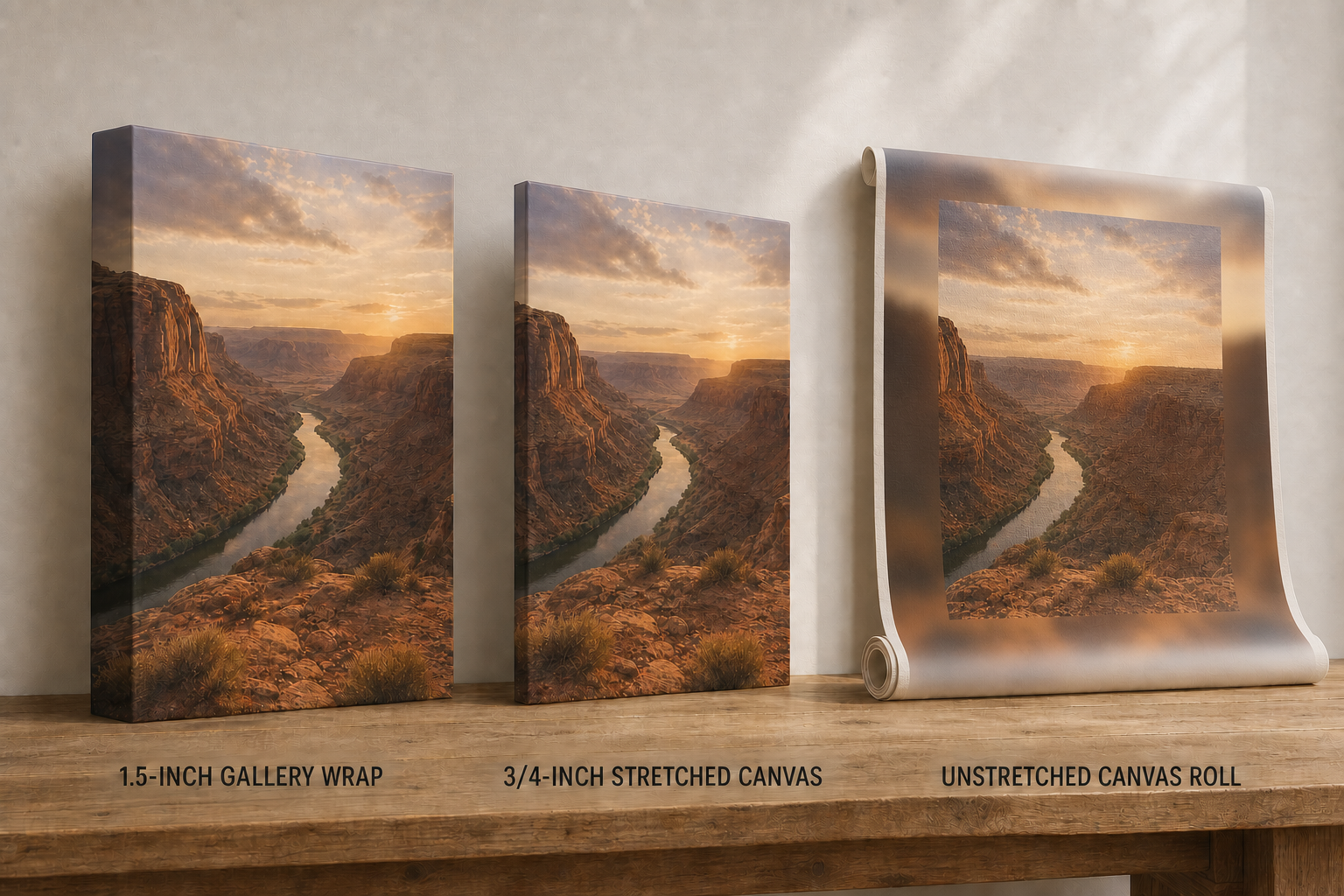
The 1.5-inch gallery wrap is a finished canvas with a bold side profile. The 3/4-inch version is also stretched and ready to hang, but it stays closer to the wall. The roll is printed canvas without stretcher bars, intended for customers who will arrange their own finishing.
This guide compares the choices by installation, room type, shipping, visual impact, and total effort. It is designed to help buyers order the correct product rather than discover after delivery that one more project is required.

In this guide
- The Three Formats At A Glance
- When A 1.5-Inch Gallery Wrap Makes Sense
- Why Choose A 3/4-Inch Stretched Canvas
- Who Should Order An Unstretched Canvas Roll
- Compare The Options On The Actual Pricing Page
- How The Formats Work In Real Homes And Businesses
- Do Not Choose Depth Before Checking The Image
- A Simple Decision Checklist
- Which Option Should You Pick?
- How Edge Treatment Changes The Visible Image
- Shipping, Receiving, And Installation
- Calculating Value Across Different Workflows
- Final Checks Before Submitting The Order
- Frequently Asked Questions
- Plan The Finished Wall Before Ordering
The Three Formats At A Glance
| Format | What arrives | Best fit |
|---|---|---|
| 1.5-inch gallery wrap | Deep stretched, ready-to-hang canvas | Large focal artwork and open walls |
| 3/4-inch stretched canvas | Slim stretched, ready-to-hang canvas | Flexible placement, groups, and smaller rooms |
| Unstretched canvas roll | Printed canvas fabric without stretcher bars | Custom finishing by an artist, installer, or experienced customer |
When A 1.5-Inch Gallery Wrap Makes Sense
A 1.5-inch gallery wrap turns the perimeter into part of the presentation. The deeper edge creates a visible three-dimensional form and allows the canvas to look complete without glass, matting, or an external picture frame.
Large photographs and bold artwork often benefit from that structure. A family portrait above a fireplace, a canyon landscape over a sofa, or an abstract design in a reception area can use the extra depth to establish a focal point.
Gallery wraps make the most sense when the wall is already chosen. Their strength is specificity: the print is built to look substantial in a particular space. Measure carefully before ordering an oversized piece.
Why Choose A 3/4-Inch Stretched Canvas
A 3/4-inch stretched canvas is the versatile middle path. It has internal wooden bars, even fabric tension, finished corners, and a ready-to-hang form, but the side edge is approximately half as deep as the gallery wrap.
That profile suits apartments, hallways, bedrooms, offices, dorm rooms, grouped portraits, and gifts. It provides the character of canvas without demanding that the artwork become the dominant object in the room.
For customers ordering several pieces, the slim option can simplify alignment. Consistent depth lets a grid or family gallery read as one collection even when the images use different orientations.
Who Should Order An Unstretched Canvas Roll
An unstretched roll is not a defective or incomplete print. It is a professional format for a different workflow. The printed canvas remains flexible because no stretcher bars have been installed.
Artists may want to build custom supports, galleries may coordinate installation locally, and customers shipping work long distances may prefer lower rigid volume. Those advantages matter only when the next finishing step is already understood.
Do-it-yourself stretching requires more than a staple gun. The bars must be square, the fabric tension must be even, corners must be folded cleanly, and the image must remain correctly positioned on the front face. Mistakes can permanently mark the print.
Compare The Options On The Actual Pricing Page
The current canvas sizes and prices lists all three presentation choices alongside available ratios. Use the page to compare the complete product and sale price rather than making a decision from depth alone.
How The Formats Work In Real Homes And Businesses
In large suburban living rooms, a deep gallery wrap can give one oversized image enough visual weight to relate to sectionals, vaulted ceilings, or broad fireplace walls.
Urban apartments and narrow townhomes often benefit from the 3/4-inch depth. It keeps artwork closer to the wall in traffic areas and makes medium-sized pieces easier to reuse after a move.
For vacation homes or rental properties, decide whether the artwork should be permanent or flexible. A ready-to-hang stretched canvas simplifies installation, while a roll may create unnecessary coordination at a distant location.
Business buyers should consider the viewer path. Work seen from a lobby entrance can be deep and large. Art placed in corridors, offices, and treatment rooms should generally use a controlled projection.
Shipping distance alone should not decide the format. A roll may reduce rigid size, but local stretching costs, transport to a finisher, and the risk of handling can exceed the convenience for an individual customer.
Do Not Choose Depth Before Checking The Image
Presentation cannot repair a weak source file. Read the canvas size guide and use the original photograph whenever possible. Images downloaded from social media or messaging apps may be too compressed for the size you want.
The edge treatment also changes the crop. A gallery wrap can continue the photograph around the sides, use a blurred extension, or use another appropriate treatment. Faces, signatures, horizons, and important details should stay safely inside the visible front area.
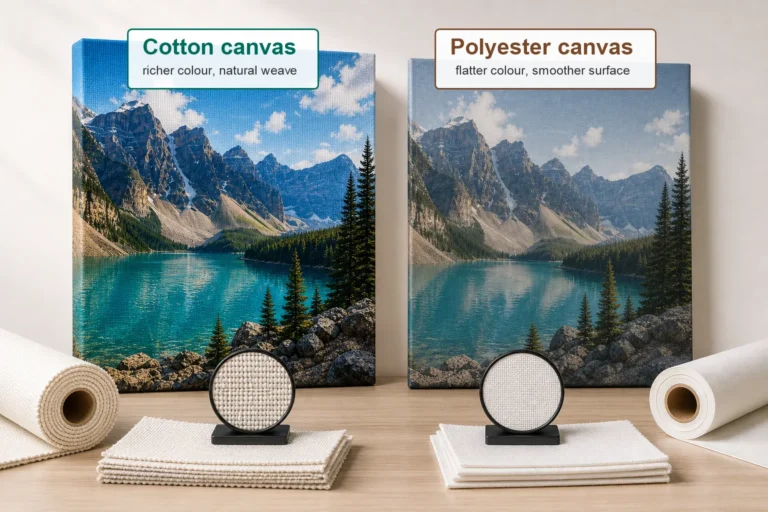
Material remains important at every depth. The cotton canvas comparison explains why cotton and polyester do not create the same surface character. You can also review the company information about canvas quality and materials.
A Simple Decision Checklist
- Choose 1.5 inches when visible depth and focal-point presence matter most.
- Choose 3/4 inch when you want a slim, complete, ready-to-hang canvas.
- Choose a roll only when stretching or custom mounting is already planned.
- Measure the usable wall, nearby furniture, doorways, and circulation space.
- Check the image crop and resolution at the intended print dimensions.
- Compare total finishing effort, not only the initial listed price.
Which Option Should You Pick?
Order the 1.5-inch gallery wrap when you want a complete statement piece and know where it will hang. Give important faces and details enough crop allowance for the wrapped edge.
Order the 3/4-inch stretched canvas when you want the broadest placement flexibility. It arrives as finished wall art and works for both single images and coordinated groups.
Order the canvas roll when custom stretching or mounting is already arranged. Ask the finisher how much extra fabric they need and whether the ordered image dimensions refer to the printed face or the total material.
Compare total ownership, not only the listed product price. Include hardware, outside stretching, local transportation, installation, and the value of your own time before deciding that a roll is the economical option.
How Edge Treatment Changes The Visible Image
A stretched canvas uses part of the fabric around the side, so buyers should distinguish print size from visible front composition. The exact treatment may continue the image, blur the perimeter, or use another finish. Review the preview instead of relying on the uncropped source file.
People, pets, typography, signatures, and architecture need extra attention. A missing ear, bent horizon, or word disappearing around the side can turn a strong image into a frustrating print. Keep essential content away from the boundary.
If the file does not contain enough room, consider a different ratio, a smaller crop, or a neutral edge. Artificially extending a background may also be possible, but it should be reviewed carefully for repeated patterns or generated artifacts.
Shipping, Receiving, And Installation
Inspect the package soon after delivery and keep protective materials until the artwork has been checked. A ready-to-hang canvas should arrive square, evenly tensioned, and free from obvious dents or handling damage.
For a roll, allow the canvas to relax naturally in a clean controlled environment before finishing. Do not force a reverse curl, apply household heat, or place weight directly on the printed surface. Follow the finisher recommendation for handling.
Install stretched canvases using hardware rated for the wall and finished size. Large work benefits from two-point support when appropriate. Avoid unstable adhesive hooks unless their rating and surface compatibility are genuinely suitable for the complete piece.
Calculating Value Across Different Workflows
Online menus show the initial product price, but the roll creates a second transaction. Add stretcher bars, labour, hardware, transportation, and the possibility of rework. A professionally finished canvas may cost less overall even when its menu price is higher.
The slim stretched option is often the value leader for gifts and general home use because no specialized knowledge is required after delivery. The gallery wrap earns its place when depth materially improves the room and the image.
Bulk and business buyers should document specifications before ordering: face dimensions, depth, orientation, edge treatment, colour expectations, hanging method, and delivery sequence. Clear specifications prevent a group of individually acceptable prints from looking inconsistent together.
Final Checks Before Submitting The Order
Double-check shipping information and the finished dimensions before submitting an order, particularly when the canvas is going directly to a gift recipient, vacation property, office, or installer in another state.
Review the image at 100 percent magnification for blur, compression, AI artifacts, and accidental text. Enlarging a file makes small problems easier to see, regardless of which depth is chosen.
Store the original master image in more than one location. A full-resolution source is useful for replacements, companion pieces, different crops, and future sizes, while a social-media copy may be too small.
Frequently Asked Questions
What is the difference between gallery wrap and stretched canvas?
Both are stretched canvases in this comparison. Gallery wrap refers to the deeper 1.5-inch profile, while the slim stretched canvas uses a 3/4-inch internal support.
Does the same photo size fit every depth?
The front dimensions can be the same, but edge treatment and crop allowance still matter. Review the preview so important content stays on the visible face.
Can I stretch a rolled canvas years later?
It may be possible if the canvas is stored correctly and has enough border, but prompt professional finishing reduces the chance of creases, contamination, or storage damage.
Which option is best for a gift?
A medium 3/4-inch ready-to-hang canvas is usually the safest because the recipient can display it without arranging a separate stretching service.
Do deeper canvases last longer?
Depth alone does not determine longevity. Canvas material, pigment inks, protective coating, construction quality, environment, and handling are more important.
Plan The Finished Wall Before Ordering
The best format is the one that completes your intended workflow. Gallery wraps deliver impact, slim canvases deliver flexibility, and rolls deliver control to customers equipped to finish them.
Check the size chart, inspect the original image at full resolution, and confirm the destination wall before ordering. A few minutes of planning protects both the print and the room.
Ready to begin? Review the current canvas sizes and prices, then upload your image. If you still need artwork, browse the art gallery before choosing the final format.